www.underlineproject.com
Network Fundamental
1/17/20263 min read
Hey there, future network wizards and digital adventurers! Ever wonder how your latest Netflix binge streams so smoothly, or how that perfectly timed email reaches its destination across the globe in a blink? It’s not magic, it's the invisible yet intricate world of computer networking, and the Cisco CCNA 200-301 certification is your golden ticket to understanding, building, and mastering it.
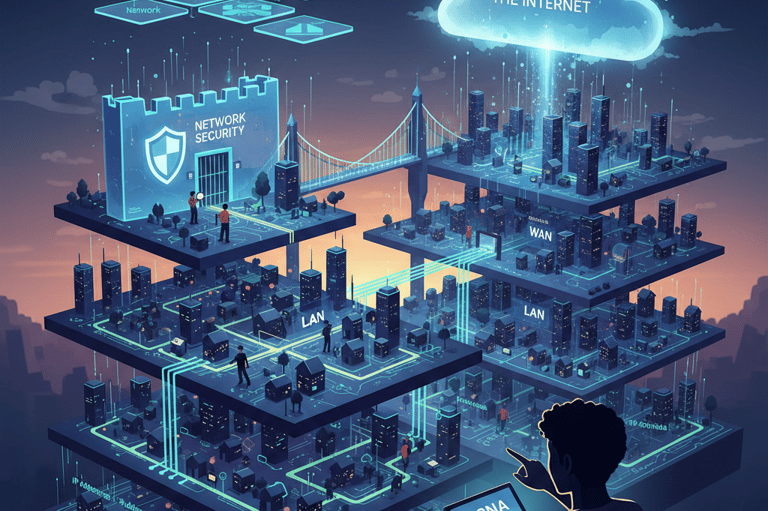
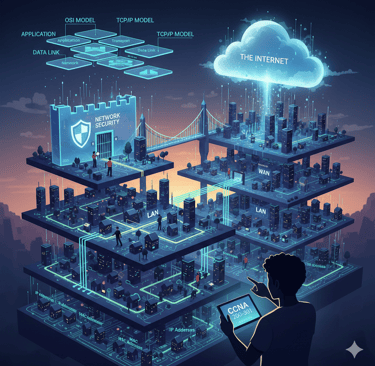
Forget dry textbooks and endless acronyms for a moment. Imagine networking as a bustling city. Every building is a device – your laptop, your phone, a server. The roads are the cables, the Wi-Fi signals are the air traffic. And the traffic lights, the road signs, the postal service? That's what we're going to demystify with CCNA 200-301.
CCNA 200-301 Networking Fundamentals
Chapter 1: The Foundation - How Does Anything Even Talk?
Our story begins with the very basics: how devices communicate. At the heart of it all is the concept of a network device. Think of your router at home. It’s like the central post office, sorting and directing all the incoming and outgoing mail (your data). But how does it know where to send it? Enter IP addresses – unique numerical identifiers for every device on a network, like a house number in our digital city.
Then we have MAC addresses, which are more like the permanent serial number of your device, hardcoded into its network interface card (NIC). It's the physical address that never changes, even if your device moves to a new IP address. Understanding the interplay between these two is crucial for troubleshooting and securing networks.
Chapter 2: Building Blocks - LANs, WANs, and the Internet
Our city isn't just one neighborhood, is it? We have local areas and then we connect to other cities. In networking, these are LANs (Local Area Networks) and WANs (Wide Area Networks). Your home network is a perfect example of a LAN – all your devices communicating within a confined space. When you connect to the internet, you're tapping into a massive WAN, a network of networks spanning the globe. The Internet itself is the ultimate WAN, a sprawling testament to interconnectedness.
The CCNA 200-301 dives deep into the devices that make these connections possible: switches and routers. Switches are like the internal traffic cops within a single neighborhood (LAN), efficiently directing data packets between devices on the same network. Routers, on the other hand, are the city planners, deciding the best routes for data to travel between different neighborhoods (LANs) and across vast distances (WANs) to reach its ultimate destination.
Chapter 3: The Language of the Network - Protocols and Models
How do all these diverse devices, from different manufacturers, speaking different "languages," manage to understand each other? This is where protocols come into play. Think of them as a set of agreed-upon rules and procedures for communication. Just like humans have different languages, computers use protocols like TCP/IP (Transmission Control Protocol/Internet Protocol) – the fundamental language of the internet.
The CCNA also introduces you to powerful conceptual frameworks like the OSI (Open Systems Interconnection) model and the TCP/IP model. These models break down the complex process of network communication into manageable layers, each with specific functions. It’s like dissecting a complex machine into its individual components to understand how each piece contributes to the overall operation. Understanding these layers is like having an x-ray vision into the heart of network communication, helping you diagnose problems and design more robust networks.
Chapter 4: Security and Beyond - Protecting Our Digital City
No city is truly safe without its defenses. The CCNA 200-301 also touches upon crucial network security concepts. From understanding firewalls that act as digital bouncers, allowing only authorized traffic, to recognizing common threats and basic mitigation strategies, you'll gain an appreciation for the importance of securing our digital infrastructure.